Search This Blog

Showing posts with label Collecting. Show all posts

Friday, April 6, 2012

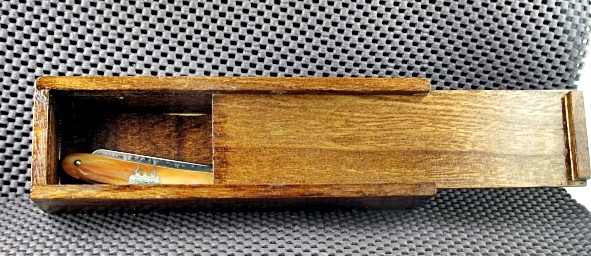
The Wade And Butcher "El Magnifico" Pressed Horn Straight Razor

Those of you who know me and who have read my postings know I have a special place in my heart reserved for Wade & Butcher straight razors.  Wade & Butcher, in its various incarnations, was one of the oldest, longest lived and best producers of shaving steel in all the history of the "modern" straight razor shave. But shaving blades were but a part of the Wade & Butcher product line.  The company was heavily involved in making all sorts of edged steel items.  A nice encapsulated history of the company and pictures of some of its extensive product line may be found here.

But I digress.  I wanted to take a moment to show you one of the "crown jewels" of the Vintage Shaving Shoppe.  This is a 7/8 "Patented Frameback" in the original box made by Wade & Butcher.  While the entire razor is a work of art, the highlight is the scales.  These are polished pressed horn with 100% of the gold lettering intact.  This is certainly a scarce straight razor in any condition, but you can spend a lifetime looking and never find one like this.  Try to keep the drooling to a minimum ;-)


Friday, August 19, 2011

Look For The Unusual For Your Shaving/Barber Collection

Don't get me wrong...I love my razors, but row after row of razors on a shelf eventually leave me a bit cold.

The fascination of the razor is not just in its varied designs and origins, it's in every that surrounded it.  That's why I've been collecting barbers items almost as long as I have been buying razors.  Everything from an antique neck duster to an old Koken barbers chair, puts all of those old razors into their proper historical context.  Old mugs and brushes make the perfect companions to the razors in the bathroom.  Old barbers bottles can really make a great display in your den or office.  But what really excites me most are the items that you NEVER see.  Items that were one-of-a-kind or so delicate that few, if any, survived.  Look below at a magnificent such example:


In all of the years I have been in the antiques and Barberania business, I have never seen anything like this item.  After an extensive search, I have concluded that there are none like it surviving in the world that are known to exist.

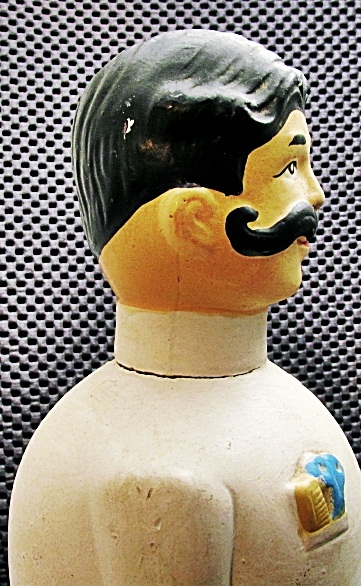
This unique item is a decorative bottle cover which fits snugly over an early 1950s era Wildroot Hair Cream bottle.  It may fit earlier bottles if they were exactly the same side. The "Barber Pole" part of the piece is a cardboard tube covered with paper that has been handpainted.  This tube travels up to the waist where it meets a Plaster of Paris figure of a barber.  The figure is hand-painted and calls to mind the barber of the Gay 90's holding a straight razor.  Overall, the painted surfaces are in excellent condition, with a few lost chips on the hair.  As it was the weakest point of the piece, the neck was broken off but was carefully glued back into place.  No plaster or epoxy was added in an attempt to disguise the break line, but it is so small that it does not detract from the beauty of this piece.  The piece is 12" tall.

Why did almost none of these survive?  Being made of cardboard and plaster, these bottle sleeves were very prone to damage by water and breakage.  Also, since they only fit specific Wildroot Cream Oil bottles, once the bottle size changed, there was no need for the cover.  Additionally, once the head broke off, the cap could no longer be turned and, once you lifted the sleeve, the head would tumble to the ground.

Bar none, this is the rarest barbers item I have ever owned.  And if you are looking to build a truly exceptional collection, it is these types of items you should be seeking.


Wednesday, July 20, 2011

Pins Are Important

Removing pins for the purpose of cleaning is absolutely forbidden in our shop, as the original pin cannot be re-installed. We, on rare occasion, replace broken scales with ones from the same era and style, but this is infrequent because we must wait, sometimes years, for a set of scales that match. We DO NOT manufacture new scales - ever.  In those cases, we retain as much of the original fastening hardware as possible, including washers and collars.  Some pin replacements are easy to detect.  You should look for:
  • Top and bottom pins that are made of different materials (most common are brass and nickel silver)
  • Pins using flat external washers
  • Pins that look different from one another, even if they are the same material (this is not a guarantee of a replaced pin, just suspicious)
It is here that I should mention something happened frequently in the life of an old razor.  Antique razors, particularly early ones, tended to be expensive (imagine spending several days wages on a razor today). So the owner did not simply throw them away if something happened to the scales or one of the pins.  It was common for a pin to be replaced, generally with a common nail, so that the razor could continue to be used.  I find this a fascinating practice and one could build an impressive collection of such period replacements.  When we encounter razors like this, we leave them with the improvised pin.
Why does it matter when the razor is removed from the scales?  The main reason is that you can no longer be sure that the razor was original to those scales.  The scales can be a vital clue to a razors age and identity.  Replacing scales with a model never used on that razor cheats history by creating a "fantasy" piece - not a genuine collectible.

Sunday, July 10, 2011

Late Night Thoughts On Old Straight Razors...A Ghost Story.

Have you ever just sat down and looked closely at a straight razor which you know hasn't seen the light of day in a century?

This is an experience I have quite often.  And looking at these old razor I sometimes feel that I can see flashes of the former owners reflected in the blades.

You could tell the folks who were in a hurry to get their shave - they tended to "lean" on the razor when honing, placing their finger on the tip of the spine as they ran the blade over the stone. Over time, of course, that part of the razor tended to be overhoned, leaving the razor narrower at the tip than the rest of the blade.  Then there is "the brute" who seemed to feel that extreme force exerted at the center of the razor would "force" the blade sharp - leaving the telltale overhoned center on the spine and, eventually a "frown" on the blade. 

Then there is the well-worn blade which is much narrower than it used to be; the hone wear is extensive but even.  Here is the sign of a man who used and loved his razor and maybe even passed it down to his son, who put yet more honest wear on it.  Then, probably around the end of WWI, it was abandoned and sat unnoticed in a drawer for decades before finally finding its way into my hands.

Maybe I am overly romanticizing a simple instrument for cutting facial hair.  But it is thoughts like these that find me generally opposed to the "extreme makeover" that seems to be so popular these days.  Actions like replacing old, structurally sound horn scales with new materials like Micarta and heavily regrinding pitted blades, just seem to take the spirit out of these once dearly loved items.

And perhaps the screaming noises we hear when putting an old razor to the grinder aren't all the mere sounds of metal giving way to rock. Or maybe it is just our imaginations running away with us in the cool, dark cellar.

Something to think about when we put that blade to our throats in the morning.

Pleasant dreams :-)

Tuesday, July 5, 2011

Going...Going...Gone! Straight Razors Rapidly Vanishing.

Take it from me, someone who looks just about everywhere for razors - they are disappearing from all markets at an alarming rate.  Several years ago, you could go to a flea market, garage sale or antique shop and find some pretty nice straight razors virtually by the boxful - sort of like you can today with common pocket knives.  This is a burning hot market folks!  When I visit antique stores, indoor and outdoor markets all over the northeast and mid-Atlantic regions, I'm finding very little material of ANY quality. I'm not even finding razors at unreasonable prices.  The last weekend I spent looking yielded just ONE razor - and it wasn't anything impressive.

The bad news is that those of you who haven't been buying have missed the "ground floor" opportunity to buy nice razors cheaply. The good news is that with availability low, values are just going to increase.  So look for and buy the very best examples you can find (originals, not the "rescales" or reground blades) - even if you have to pay more than you ever have before.  Wet shaving and straight razor collecting is growing.  Even the DE razor market, which used to be completely dead (you could easily find Gillette "Fat Boys" for a couple of dollars.) is red hot.  Mark my words - we haven't come close to seeing the top of this market.  If you are an investor, buy now and put a lot of money in your pocket later. If you are a collector, buy the things you love while you can  - your opportunities are shrinking. 

In the meantime, I will, as always, keep my eyes open for all of you - picking up both the good and the common stuff when I can.

Sunday, June 26, 2011

The Vintage Shaving Shoppe Gets "The Chair"

It's not just about the razor or the quality of the shave - at least it isn't for me and for most serious collectors I know.  Razors hanging on a wall or even in a nice glassed-in case look somewhat odd and forlorn set there alone in a living room or office.  The finest and most enjoyable collections I have ever seen are put in a setting that gives it context, history...a flavor of shaving past if you like. 

It is with this in mind that I am proud to announce that The Vintage Shaving Shoppe has just laid its hands on a near mint condition 1920s era Koken Barber's Chair with child seat.  This beautiful item is all porcelain and nickel plated iron. It has the original headrest, original upholstery (or if re-upholstered, it was done many years using original materials).  The hydraulics work wonderfully and the chair tilts and swivels like new.  The chair is SO good, that all I have done to it is added hydraulic fluid, lubricated the moving parts and polished and protected the finishes. The only work I am having done (at no small expense) is re-plating the two footrest surfaces with nickel to return them to "showroom" condition and re-upholstering the child seat.  The chair should be available for sale in two to three weeks for $2,500.  It weighs approximately 350 lbs, so local pick up is required.  I will work with serious collectors who don't mind the considerable expense of having the chair shipped to a distant location.

I have also been buying other items that will provide context to and enhance, your collection, including two Gillette display cases, two wooden Sanitizer cabinets and a early 20th century beauticians license.  Please feel free to contact me at assistance@vintageshavingshoppe.com if there are items you are searching for that I may not be currently displaying.

Here are a few "preview" pictures of the chair:


Monday, June 20, 2011

Congratulations To Winning Bidder: The Unger Bros. Sterling Silver Scaled Straight Razor!

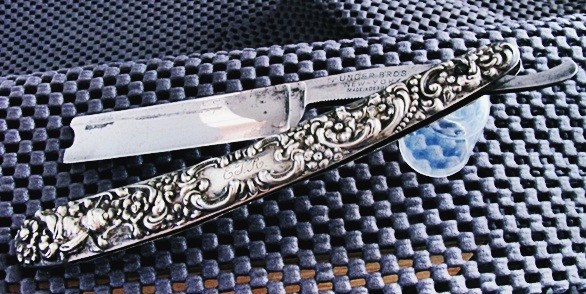
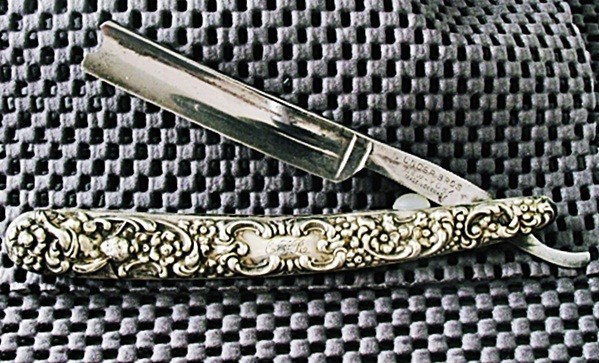
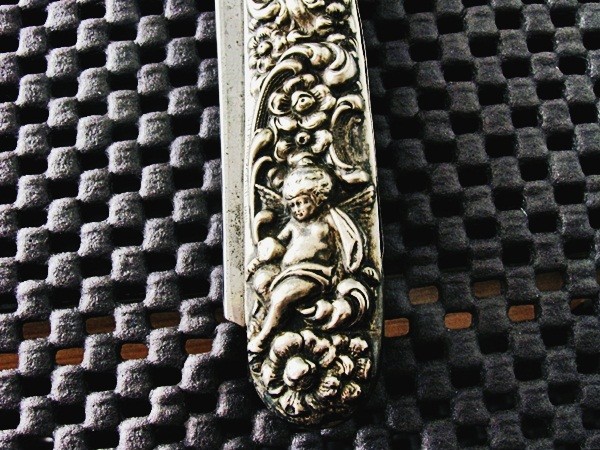
Congratulations to the gentleman with the discerning eye who won our auction on eBay tonight for the rare Unger Bros. sterling silver scaled straight razor.  He paid a total of $606 for one of the rarest razors I have ever handled.  The spirited bidding started at $299, ascended to $380 where it sat for a few days, before rising to the winning bid price in the last few minutes of the auction.

Keep your eyes open for "bargains" like this one.  It is the razors that were expensive and rare at the time that they were made, that will end up being the best investments of today and tomorrow.  Here is one last look at this fine example of the art of the Unger Bros. of New Jersey before it "disappears" into a private collection.

Again, congratulations to the winner!


Wednesday, June 1, 2011

Lusting After Ivory Wedges? Moss & Gambles 7/8 Ivory Wedges In Box!

For all of you folks who have yet to see a perfect pair of large Ivory Scaled 7/8 Wedges, check out these beauties!  They were made by Moss & Gambles of Sheffield at the Franklin Works. A careful examination of the razors would put them in the late 19th century. Moss & Gambles was at Franklin Works and in operation from about 1860 to 1911.

These razors were truly an expensive top-of-the line pair, both in their time and now.


Friday, May 27, 2011

Spring Cleaning & Organizing

Been spending quite a lot of time trying to organize my inventory.  Not surprisingly, since I have been in antiques for quite a long time, there are MANY things other than razors that I have.  One thing I am doing that does not sound terribly exciting - but actually is - is creating a computerized inventory of every razor I have.

"So what does that do for me?" you ask.

Well, I'll tell you.  When I am finally done (I am up to around 150 razors in the database now), I will be able to instantly search and location razors by:
  • Brand
  • Grind
  • Scale Material
  • Shave Ready/Not Shave Ready
  • Blade Size
That should be of GREAT interest to all of you specialists out there.  Now if you are looking for a Wade & Butcher "cleaver" I can tell you how many I have that are shave-ready.  Do you hanker for razors with ivory scales?  I will be able to find our how many I have and exactly what manufacturer made the blade in less than a minute.  Considering that I have nearly 1,000 razors in stock, that is going to be a very interesting database.

Since I do all of this work in the evenings, it will please me greatly to have my two daughters over the summer (part time) assisting me with this project.  While they are somewhat less than enthusiastic about their "summer job," I believe it will teach them the value of hard work...well, I can dream, can't I?

Sales of the diamond slurries and men's shaving products on the new website have been excellent (thank you all!)  I am working on getting some razors on the site.

In the spirit of my spring cleaning, you will find me disposing of some very nice items that are completely unrelated to shaving.  Today I put up a killer collection of working vintage guitar effects pedals.  You should check them out if you play, or if your kids do.

Thanks again for your business and for reading my blog!

John

Friday, February 25, 2011

Product Review: "Buck & Beard Hand Made Damascus Steel Razor" - Stay Away...Far Away!

Like many folks I know, I've always wanted a true Damascus razor.  So when I saw one on eBay, I was hopeful that this razor would be something special. It certainly looked cool enough in the pictures. When I received it, the lack of quality was immediately apparent. As you know, I typically buy antique and vintage razors (almost a thousand of them to date). I have bought a new razor, not counting this one, once. When I buy something modern, I expect perfection, or at least something close to it. These are my observations on the razor & sleeve that I received:

  • Rusty rivet backs on the leather pouch
  • Poor craftsmanship on the scales
  • ONE of the screw-in pins has a lock washer on the outside. Looks like it was done to compensate for a blade that would not close properly
  • Significant crack at the end of one of the scales
  • Poorly fitting, misshapen wedge
  • Rust on the edges of one of the internal washers which seem to be made of cheap steel
  • Steel itself seems to be of low quality and weight - not what one would expect of a true Damascus blade
  • As shipped, the edge had the bite of a butter knife. I was NOT expecting shave ready, but this one couldn't cut cardboard
  • The blade does not lay flat on the hone, so there is no way that it will produce an even edge. The only way to hone it would be to apply tape strategically to the spine in multiple locations in an attempt to make it lay flat. You should not have to do this on a "hand-crafted" American made razor.
I was honestly hoping for something really nice and was very disappointed for the reasons above. Quality control has to be just awful. If this razor is truly American made, they must have imported the craftsmanship levels from Pakistan.  Yes folks, it is THAT bad.

This is one razor that is most DEFINITELY going back to the seller.  Negative feedback regarding the quality of the razor will be left on eBay in the hopes that others will see it and avoid this product.

The seller is bucknbeardamascusknives

Stay away from this product.

Sunday, February 6, 2011

New lot of old straight razors to be posted on eBay

With so much focus on our successful launch of sharpening supplies, we have been neglecting our straight razor business.  No more! Starting this Sunday, we will begin listing straight razors (mostly shave-ready), many of which you haven't seen before, on eBay.  They will include: Wade & Butcher, Clark & Hall, Peculiar, Cougar and a unique carbonized steel IXL Wostenholm!

Monday, January 17, 2011

You Lucky Guys! Some Of The Best Razors We Have Ever Had.

I envy you guys sometimes.  You actually get to keep the really cool razors - I simply find them and get them to the right people.  If you are a serious collector, you have probably noticed that the more striking examples are getting harder to come by.  And since I am constantly looking, you would be correct.  That means that when I am lucky enough to find them, I have to pay more.  This means you have to pay more.  Tough break, but that's the way it is - supply and demand.

The good news is that for those of you who are buying for both love and investment purposes, your foresight is starting to pay dividends.  And there is still a long ways to go.  In my opinion, prices are still low - just not as low as they once were.  Now that much of the best stuff is in collections, you should be on the lookout for excellent examples of the art - even if you have to pay top dollar for them.  The ones that I project will increase the most in value are original early examples.  I happen to have picked up two of these just this past weekend.  What was particularly gratifying was that they were not just plain razors in horn scales - most common in that period.  Both of them are original tortoise shell, but very different.  The first of the two I would place at the end of the 18th century.  It is a Clark & Hall and it was designed as a showpiece.  What do I mean by that? Well it has several features that had nothing to do with the practical utility of the razor, including
  • Fancy washers on both pins
  • Polished tortoise shell scales
  • Mirror finished blade
  • 3 pewter shields 
 These are all features that were not necessary or commonplace and they cost the buyer a good deal more than an average razor would.  To my delight, the blade had retained its original shape and finish - it was not reground  or reshaped as so many of the period were.  It is solid enough to make shave ready and I will have it up for sale once I am done.  As is our tradition, nothing else will be done to this piece of history.  Private purchase inquiries are welcome.

The other razor is also of the fancier variety - having iron pins with fancy washers and also in tortoise shell. This one has no pewter shields and the blade is not mirrored.  It has no manufacturer and it marked "Cast Steel."  It is in excellent condition and I would put it VERY early 19th century - no later than 1815.  Honing this wedge to shave-readiness will likely take a couple of hours, but I look forward to it.

I should have pictures in a few days.

Saturday, November 13, 2010

A Close Shave With Death - The Truth About Those Fancy Shaving Mugs

In the last few years, increasing numbers of collectors have been taken by the beautiful variety of shaving mugs that used to grace barber’s shelves by the dozens.  Of particular interest are the so-called “occupational” mugs – those that depicted the various occupations of the people of the town.  There were mugs for the butcher, the baker and the candlestick maker, each featuring images that illustrated their occupations and often their name.  There were also mugs for lawyers, train conductors, tailors, chimney sweeps and even baseball players.  Those mugs without pictures often had the name of their owners proudly painted across the pure white or otherwise decorated surface.  Some of these styles of mugs are worth just a few dollars.  Others, especially the occupational mugs, can fetch hundreds or even thousands of dollars from serious collectors.
Typically, these mugs sat on a shelf in the barber’s shop, yet they were the property of the owner of the mug.  In fact, when the mug’s owner died, the mug was returned to the family by the barber.

While we are on the subject of death, I wanted to pass along a bit of shaving history that is slightly macabre…and the REAL reason for those cheerfully decorated mugs – fear of the Grim Reaper. Since it is likely that you weren’t born in the early 1900’s, you might not be aware that it wasn’t until 1928 that Alexander Fleming discovered penicillin.   And it was a good ten years before it was widely used.  If you were unlucky enough to get a nasty bacterial infection prior to Fleming’s discovery, you just had to ride it out and hope for the best.  

So those gentlemen who could afford them, bought their own mugs primarily to avoid catching another customer’s blood-borne bacterial infection.  It was THEIRS and could never be used by another customer.  Those who could not afford their own, took their chances that the barber washed his common mugs carefully between shaves.

In truth, if the barber employed even the most basic hygiene methods, like a good scrubbing with soap and water, the chances of passing along an infection would have been nearly zero; but it does say something about the tenor of the times before antibiotics were commonly available. 
Anyone for a nice personalized shaving mug?

Tuesday, November 9, 2010

The "Little Stropper" Is Coming To Town!

Another of those "looks" from the wife again.

Those of you gentlemen who are married or have similar long-term entanglements, are familiar with the glare that only people together for many years can share. In my case, this particular look is reserved for those days when the postman brings another brown box to our doorstep.  She knows that it is even money that the box contains some manner of sharpening device - a hone, a strop, stropping paste, hard wool felt, strop conditioner, balsa wool (yes, you can sharpen on this too), a slurry stone, diamond spray or something even more exotic.   And it's always the same question: "Aren't those damn razors sharp enough for you yet?"  My stock answer, "not if I can get an even BETTER shave out of them." It never seems to satisfy her.

If you are a true connoisseur of the straight razor shave, you understand exactly what I'm talking about.  You also probably know that it isn't all that difficult to get a hair-cutting edge on your razor - this can be done with honing stones (although the cost of purchasing all of the required hones can be prohibitive for the average gentleman.  But a sharp edge doesn't guarantee you a comfortable shave - for that you need to properly strop your razor.  To most people, a strop is just a leather strap hanging in their bathrooms; from a hook, towel bar, or whatever else is handy.  But there is more to stropping than running your razor over that piece of hanging leather.  And it was from this simple idea that Little Stropper was born.  Little Stropper products:
  • Ensure you get a closer, more comfortable shave;
  • Travel wherever you can take a straight razor - no hooks or towel bars required;
  • Extend the life of your razor.  This means longer intervals between trips to the "honemeister;"
  • Have been designed by me for my own personal use, and have also been put to the test making hundreds of razors shave-ready for our customers all over the world;
All Little Stropper products are completely made or finished BY HAND right here in Pennsylvania.  For the time being, I am handling the manufacture and finishing myself to ensure that they meet my personal specifications.  These items will be numbered and signed by me. 

Little Stropper is an exclusive brand of Vintage Shaving Shoppe, LLC.  We will not be selling Little Stropper products anywhere except from our dedicated website, littlestropper.com, or from vintageshavingshoppe.com.   The dedicated website is already up and running.  However, products are not yet available for sale there yet, but you can expect them to be available in the next week or two.  You can check the littlestropper.com  website periodically.  You will also be notified automatically when products are available if you are a Follower on our blog or a Fan on our Facebook page.

I am very excited about our Little Stropper product line because I know that every one of our products will bring you a closer, more convenient and more enjoyable shaving experience.  If you have any questions, please feel free to contact us at assistance@vintageshavingshoppe.com.

Here is a "sneak preview" of two of our products...

The StropBrick: A hefty chunk of solid wood (Rosewood, in this photo) with three 6" stropping surfaces - one plain strip of bridle leather a shade over 1" wide, and two bridle leather strips 5/8" wide each treated with with a lightly abrasive stropping paste.  It is perfect for traveling or simply keeping on the bathroom shelf. It's always ready to use and each one is a work of art.  Clear rubber "feet" keep the StropBrick level and secure if you wish to use it on a hard surface.  Personally, I prefer to hold it in my hand.


The StropBox: If you travel, or if you are simply short on space for your shaving items, you will appreciate this ingenious tonsorial item.  Part high-quality vegetable-tanned leather strop and part storage case, the StropBox will keep your cutting edge smooth and provide storage for your favorite razor and anything else you can fit inside.  A sliding panel secures the contents.  I always grab my StropBox whenever I travel overnight and keep a tube of strop paste and a small barber's hone inside. Since the sliding panel is practically invisible, it is also a great place to keep some extra cash, jewelry, etc. on your trip.The StropBox is 100% solid wood (not plywood or pressboard) which has been hand-stained and features two coats of polyurethane on the external wood surfaces to water resistance and durability.  The stropping surface is a generous 8 1/4" long by 2 1/2" wide with leather hand-selected to have the smoothness and "draw" needed to tame the edge of your razor.  You may use stropping paste with your StropBox or we can paste it for you for a small additional charge.


Saturday, November 6, 2010

My Kingdom For A Reference!

 Having spent a lot of time in coins, stamps and other popular collectibles, I am a bit spoiled by the wealth of reference materials available on most of these items. Razors, on the other hand, are dismally documented by comparison, as are many of the companies that manufactured them. Try Googleing for information on Wade & Butcher - a MAJOR manufacturer for over a century and you will find very little. With razors you are basically stuck with The Standard Guide and Goins. I have found another free reference put out by Canada that isn't bad, but that it about it. And these guides themselves and sparse and incomplete. By saying this, I mean absolutely NO disrespect to the authors of these works. They have done a mammoth amount of work compiling what they have. But probably if you asked the authors (sorry, cannot ask Mr. Goins, as he sadly passed away), they would probably express the same dissatisfaction and frustration as I feel. There were SO many razor manufacturers making SO many brands. And unless they were also gold or silversmiths, the only documentation on them might have been their handbills, barber supply catalogs and their own catalogs.

But maybe what they could not do on their own we can do together. I would like to start a project where any of you anywhere who has a barber supply catalog, a manufacturer's catalog, an old flyer or anything on razors or Barberania, scan it into pdf format. If you cannot do that, send it to me and I will scan and return it. The only proviso is that these documents become part of the public domain so everyone can use them. I don't believe that there would be copyright issues on anything that old (some lawyer can email me if there is). It would be such a great project and do so much to advance the hobby.

I, for one, would love to get a razor and be able to find out how much it sold for, the history of the manufacturer and whether or not it was used in a particularly dastardly crime.

Does anyone know what razor Humphry Bogart shaved with?

Monday, November 1, 2010

Think About The Unthinkable & Sleep Better Tonight

You are a razor collector, a knife collector or a car collector.  You have spent countless nights, weekends, holidays and even vacations adding to and caring for your collection.

Have you ever thought that in a matter of hours...or even minutes, it could be gone?

If you are like me, just about now you are feeling a chill going up and down your spine.  Speaking personally, I have seen what happens to celluloid when it catches fire - it's scary.  And when I think about how many razors I have with celluloid scales, it's scarier still.  Knife collectors will be able to relate to this as well.  But you don't have to collect cutlery to be concerned.  A fire, flood or theft will affect ANY collector who has poured their heart and their dollars into their collection.

This is why you should give some SERIOUS consideration to insuring whatever you collect. If you think that your homeowners insurance will cover your collection, you need to take a very close look at your policy and speak with your agent.  More than likely, coverage will be EXTREMELY limited - both in dollar amounts and in the hazards against which you are protected.  So if you are a serious collector, you should be considering specialized insurance that will financially protect you against all hazards and for the full value of your collection.

Nothing will compensate you for the heartbreak of having your collection destroyed by fire or stolen; but with the right insurance from the right company, you will at least have the money to start rebuilding what you have lost.  For most collectibles, American Collectors Insurance is an excellent choice.  Their premiums are reasonable and their underwriter (the company actually responsible for providing the insurance and paying the claims) is rated "A" (Excellent) by AM Best - the top independent insurance rating agency.  As a licensed insurance agent, these rating are essential to deciding where to place my client's insurance.  I do not place anyone with a company rated below "A-."

American Collectors doesn't insure EVERY type of collectible (they don't insurance coins and stamps, for example), but they would certainly be one of my first recommendations to any collector looking for peace of mind and financial protection.  You can reach them at their website or give them a call at 1-800-360-2277.

Make the call and sleep better tomorrow night.

Tuesday, October 26, 2010

The Joy Of Parts – Why I love My Razor Junkyard

In addition to my line of shave ready razors, I buy a significant number of broken razors that have no apparent value or historic importance (keep in mind that some razors, even when broken, DO have value).  

Why would I pay for broken razors?

These razors that would normally be discarded are a valuable source of material for someone who studies razors and repairs them.  I have written several articles on razor restoration and how I am generally opposed to it, beyond a basic cleaning and honing.  However, a blade with broken scales or a pair of scales holding a broken or badly corroded blade will never be a shaver, nor, unless it is something truly special, will it ever be a collector’s piece. 
When I DO make repairs, I only use parts that are original to that type of razor.  And given the thousands of different makes of razors out there, one needs MANY parts to have a chance at having the right one needed for an authentic repair.  If I cannot repair a razor authentically, I don’t do it.  That’s why broken razors are so valuable to me.  They provide the source of genuine parts that I need to make broken razors whole again.  In a way, I am running a personal, automobile-style junkyard for razors.  Until I find original parts, beautiful blades sit in individual baskets waiting for scales; scales await blades and proper collars.  The only items that absolutely cannot be salvaged from an old razor are the pins.  That is why I am against the removal of pins for the purpose of cleaning a razor.  Once they are out, a new one must be fashioned to replace it.

Just like in a good junkyard, organization of your parts is important.  I organize them by the GOOD part in the broken “whole” razor.  This leaves me with two primary bins:
  • ·         Good blades with broken scales
  • ·         Good scales with broken/badly damaged blades
 I try to keep the broken razor whole until I need the part, as it provides me with valuable information about what goes with what.  I also keep a few other bins of particularly tiny items:
  • ·         Pivot pin washers
  • ·         Cut pivot pins (as examples)
  • ·         Pin collars
  • ·         Wedges
Even these items I try to keep together as long as possible.  One thing I do NOT keep are celluloid scales which have begun to decay.  If I want to document the blade that went with such scales, I will photograph it.  Decaying celluloid is too much of a hazard to metal to warrant keeping anywhere near your collection.  But be careful how you dispose of celluloid scales…they go up like the Hindenburg when exposed to extreme heat or flame.  If you feel the need to have this demonstrated, take a SMALL piece of celluloid and clip it to the end of a hemostat or tongs, then light a match to it and stand back – the ensuing conflagration is impressive (A completely unrelated, but equally cool fire can be made by touching the contacts of a 9 volt battery to 0000 steel wool, but this will be the subject of another article).  Make sure you are outside or standing near a sink when you try either demonstration.

It gives me a great deal of personal satisfaction to restore a razor to its original condition.  If you feel the same, you might want to start a razor “junkyard” of your own.

Monday, October 25, 2010

FREE Reference Materials For Razor, Cutlery & Shaving Item Collectors

What others are selling, I am offering online for FREE as a public service to my fellow collectors.

AS I have written before, many collectors of straight razors in particular, suffer from a lack of sources for identifying the makers of their collectible razors. There are a couple of published references out there, but there is so much left undocumented. The Vintage Shaving Shoppe has initiated this project to make reference materials available to collectors worldwide. We hope that you will benefit from these links and that you will contribute to them, so we can work towards creating a truly comprehensive reference.

Your comments are welcome!

Hyperlink to The Goldsmiths Jewelers and Silversmiths of London 1863 directory

Hyperlink to Miscellaneous Bayonet Markings

Hyperlink to The Journeyman Barber

Hyperlink to The Gillette Blade

Hyperlink to Perfumery & Kindred Arts

Hyperlink to Trademarks On Base Metal Tableware

Sunday, October 24, 2010

Today's Question: Can You Bring An Old Scratched, Corroded Razor Back To life?

I received an email yesterday and I thought the question might be of enough general interest to post the question and answer in my blog.  Here it is:

"I know nothing about re-conditioning razors. I thought there might be a way to buff the blades and make then shiny and new again. It sounds like that is not the case. I am guessing that if a razor has a faint etching nothing can be done. I pulled out a razor tonight that has an etched lion on the blade but the etching is faint. My thought was maybe you could bring it back to life. Should I assume it is not possible?   Thanks for your thoughts and time."

Dear Writer,

Etches are particularly tough - especially if they are photochemical and not mechanical.  Mechanical etches (those made by an etching tool) tend to be deeper than their photochemical cousins, which are much shallower and more delicate and can be worn off simply by normal use.  Obviously, any sort of harsh abrasive would destroy them, and if that abrasive is applied under power, the delicate design can be destroyed in seconds.

Keep in mind that even the lightest scratch is actually a depression that has been made in the metal.  In the case of a light scratch, that depression is very small, but in the case of corrosion, that depression is much, much larger.  As I have mentioned in articles I have written on the topic, the only way to "remove" a scratch or corrosion spot is to remove enough metal around that spot to reach the bottom of the depression made by the defect.  As you can imagine, that isn't so hard when the scratch is light, but when it's deep, it can be a huge project.  And that assumes that there is enough metal there to do it. This usually isn't a problem with a wedge, since they are so "meaty," but it is often a major issue in dealing with more modern, hollow-ground razors - German ones in particular. These problems increase when your defect is near the edge, where the metal can be paper thin.

Personally, it is my practice never to remove metal below the original base layer of the razor's surface.  So in that respect, I don't really "restore" razors.  But I do find ways to make them look better within my rather strict parameters.  One of the most significant things you can do is to remove surface rust.  You can remove very light rust with 0000 steel wool and a light oil like WD-40.  This will not do anything for real corrosion or severe rust, but you will find it helps a lot on very light coatings of bright orange rust. To keep the razor rust free, it is important to keep a light coating of oil or a protectant such as Tuf-Glide on the blade at all times when not shaving with it.

I hope this is somewhat useful to you.

Saturday, October 23, 2010

Do You Have A "Want List" Yet?

Common in coin collecting, the "want list" (WL) simply represents the items you are looking to add to your collection. For coin collectors, it's about filling in the holes in your dates and mint marks. With razors, you have considerably more flexibility. One of my clients had the great idea to collect razors made in his state. Other people collect certain brands, others a specific style of scales, other collect Sheffield, others Solingen.

There are many ways to collect as I have mentioned in another posting. So you might want to sit down and make a list of the razors you need to create your dream collection. I am trying to figure out how to create an application that will let you maintain a want list that I can track, so I can contact you when I have something that you need. Until then, feel free to email us at assistance@vintageshavingshoppe.com with your hearts desires. I will do my best to fulfill them.