Search This Blog

Showing posts with label Opinion. Show all posts

Friday, August 19, 2011

Look For The Unusual For Your Shaving/Barber Collection

Don't get me wrong...I love my razors, but row after row of razors on a shelf eventually leave me a bit cold.

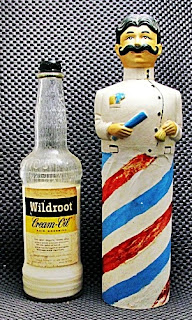
The fascination of the razor is not just in its varied designs and origins, it's in every that surrounded it.  That's why I've been collecting barbers items almost as long as I have been buying razors.  Everything from an antique neck duster to an old Koken barbers chair, puts all of those old razors into their proper historical context.  Old mugs and brushes make the perfect companions to the razors in the bathroom.  Old barbers bottles can really make a great display in your den or office.  But what really excites me most are the items that you NEVER see.  Items that were one-of-a-kind or so delicate that few, if any, survived.  Look below at a magnificent such example:


In all of the years I have been in the antiques and Barberania business, I have never seen anything like this item.  After an extensive search, I have concluded that there are none like it surviving in the world that are known to exist.

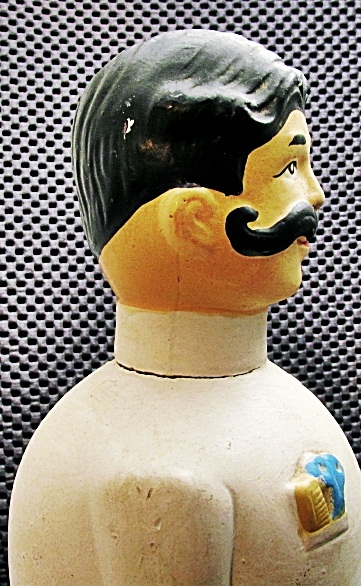
This unique item is a decorative bottle cover which fits snugly over an early 1950s era Wildroot Hair Cream bottle.  It may fit earlier bottles if they were exactly the same side. The "Barber Pole" part of the piece is a cardboard tube covered with paper that has been handpainted.  This tube travels up to the waist where it meets a Plaster of Paris figure of a barber.  The figure is hand-painted and calls to mind the barber of the Gay 90's holding a straight razor.  Overall, the painted surfaces are in excellent condition, with a few lost chips on the hair.  As it was the weakest point of the piece, the neck was broken off but was carefully glued back into place.  No plaster or epoxy was added in an attempt to disguise the break line, but it is so small that it does not detract from the beauty of this piece.  The piece is 12" tall.

Why did almost none of these survive?  Being made of cardboard and plaster, these bottle sleeves were very prone to damage by water and breakage.  Also, since they only fit specific Wildroot Cream Oil bottles, once the bottle size changed, there was no need for the cover.  Additionally, once the head broke off, the cap could no longer be turned and, once you lifted the sleeve, the head would tumble to the ground.

Bar none, this is the rarest barbers item I have ever owned.  And if you are looking to build a truly exceptional collection, it is these types of items you should be seeking.


Friday, June 10, 2011

A Word To The Hard Done DE Razor User

Just a short posting to humbly apologize to my DE-shaving friends who felt that I was a bit hard on the practice in my recent article, "Going Green By Shaving Straight." 

Shaving with a permanent, all-metal razor that uses all-metal blades is certainly MUCH kinder to the planet than using plastic disposables.  It also produces an outstanding shave that provides much the same benefits to the skin as does straight razor shaving.  While my heart will likely stay with my beloved antique straight razors, I have to acknowledge that DE shaving is still pretty "green" (especially if you have one of those old medicine cabinets with the slot that lets you drop the used blades between the beams of your house).  So I tip my badger brush to all of my DE-shaving cousins - gentlemen all!

Tuesday, June 7, 2011

Going Green By Shaving Straight- Four Alternatives To Disposable Plastic Razors & Cartridges


Going Green By Shaving Straight
Four Alternatives To Disposable Plastic Razors & Cartridges

By John H. Tischler

(Note: The author sells vintage & antique straight razors & safety razors)

There is something that unites men of all nationalities, colors, religions and sexual preferences; something as basic to our genetic code as our desire to avoid yard work – we all grow facial hair.  For the majority of us who want to remove it without having a negative impact on our fragile planet, this article was written for you.

A Close Shave For Mother Earth

Few men will argue that shaving with disposable razors (either the plastic “throw away” variety or those with disposable cartridges) isn’t bad for the environment.  The approximately 68 million men in the USA alone using plastic disposable razors produce waste that consumes an astounding 34,000,000 cubic feet of space. And this does not include the space taken up by shaving cream cans and the packaging for all that plastic.  Much of this waste is not recycled and ends up in landfills or is dumped into our oceans.  But the news gets worse – each plastic razor or cartridge requires fuel (primarily oil) to both manufacture the item itself and to power the machinery that produces them.  Throw into the mix the toxic chemicals which are either used in, or are waste products of, the manufacturing process, and the business of making, using and disposing of plastic razors becomes nasty indeed.

The High Cost Of Hair Removal

A hundred years ago, you could get a barbershop shave and a haircut for “two bits” (25 cents).  Not anymore.  Today, the cost of all that plastic, packaging and the advertising dollars spent to support the industry, really adds up.  And the cost is passed onto the consumer.  In a single year, the razors, cartridges and shaving gels/creams that you will need to keep your face smooth will cost you, on average, around $225.  This cost can be even higher of you toss your expensive cartridges at the first hint of dullness or rust.  For the sake of comparing this with other options, let’s assume that a man has an average of 68 shaving years over his lifetime; and that each year, shaving with disposable razors will cost him $225. To calculate the number of shaves in a lifetime for the remainder of this article, we will use the following formula: 68 (years) * 365 (shaves per year) = 24,820 shaves. So, in in the case of shaving with disposable razors (the Gillette Mach 3 is used in this example):

Lifetime Cost: $15,300. ($225 * 68 Years)
Cost Per Shave: $.62 per shave ($15,300 / 24820)

These costs do not account for inflation or "upgrading" the products you use over time, so the lifetime cost is likely to be higher. Of course, the total cost can decrease if you use razors of lower quality.

To sum up, shaving with disposable razors is very expensive – both in your direct costs which will only increase every year, and in the damage caused to our already stressed ecosystem.


Alternatives To Plastic Disposable Razors

Hopefully at this point, you are willing to examine the alternatives to the plastics.  Fortunately, you do have options which will both cost you less money and decrease your “carbon footprint.”  

Solution #1: Permanent Laser Hair Removal With Electrolysis

About: The desire to eliminate the burden of daily facial hair removal is nothing new, but modern technology has made it more realistic and affordable than ever.  The best known and most reliable treatment for all skin colors and types is electrolysis.  Around since the late 1800s (but significantly improved over time), electrolysis involves inserting a tiny needle into each hair follicle on the face and “zapping” the dermal papilla with electric current.  This renders that follicle permanently incapable of supporting hair growth.

Pros: Your shaving burden will be substantially decreased or even eliminated.  This also makes this method among the “greenest” of all the solutions presented here.

Cons: Each time that needle is inserted into a hair follicle and electricity is passed through it, it hurts.  According to an article in Men’s Health magazine, the average man has approximately 30,000 follicles on his face.  If each and every one of them are “zapped” with electricity, that is PAIN x 30,000. That's some serious agony. As if that were not a sufficient deterrent, an interesting article on the topic of facial hair removal from the transgender community, reports that it can take from 1 to 4 years of treatment to finish the job.  That’s a whole lot of pain just to avoid shaving.   Treatments cost between $25 and $250 each, depending on how many follicles are treated, where you live and the experience of the technician (and trust me, you don’t want someone who sucks at it.)  The whole job can take up to 4 years and cost up to $20,000.

Grade: D (for cost, time and suffering)

Solution #2: The Electric razor.
About: Electric razors have been around for decades.  It was invented in 1928 by Colonel Jacob Schick.  There are versions that work dry, others that let you use creams and lotions and even models that allow you to shave in the shower.  With daily use, a quality electric razor should last you 2-3 years before a replacement is needed or desired due to either expensive parts or the internal rechargeable battery wearing out.

Pros: Using an electric razor solves the waste problem – sort of. You aren’t throwing out plastic every day and you typically aren’t buying cans of shaving cream – all good news.  They do not consume a great deal of electricity and, if you use the car adapter that comes with some of the better razors, you will be even “greener” – although shaving while driving is not something I would recommend.

Cons: It’s true that an electric razor lasts considerably longer than plastic disposables, but you will go through quite a few of them in your lifetime.  Unless you dispose of them responsibly, these devices (the rechargeable batteries in particular) are very bad for the environment.  A good electric razor is also not cheap – a good one will set you back $100 or more.  So if you buy a new razor once every 3 years, the cost adds up.  Finally, of all the options examined here, this type of razor, hands-down, will give you the worst shave.

Final Grade: B

Solution 3:  Non-Disposable Safety Razor With Disposable Metal Blades

About:  While the identity of the inventor of the “safety razor” (a device which exposed only the shaving edge of a blade to the face) is a hot topic of debate in the shaving history community, there is little doubt as to the man who made this type of razor both practical and popular – King Camp Gillette.  The earliest safety razors did not use disposable blades, but Gillette’s did right from the start. His blades were also sharp on both sides (known as “double-edged” blades) –giving the user two sharp edges for the price of a single metal blade.  This was important, because the early “disposable” blades were not cheap.  But what really converted the male population of the United States to the Gillette razor was the fact that during WWI, the US Government issued Gillette safety razors and blades to the entirety of the armed forces and allowed them to keep their shaving kits when they were discharged.  The art of shaving was transformed virtually overnight.

Pros:  As the “runner-up” solution, the safety razor with disposable metal blades has a lot going for it.  Since the razor is permanent and typically made of metal, you can use it for years or possibly a lifetime with proper care, although you might find it fun to use and collect a variety of these razors.  And since you can always pull a fresh blade from the pack, a great shave is always close at hand.  Additionally, the thin metal disposable blades are MUCH less expensive than the plastic multi-blade cartridges – a 10 pack of Merkur blades sells on the Wed for about $5.75+ $3.99 shipping. If you can get an average of 4 shaves from each blade, that’s an average cost per shave of just 24 cents.  Plus, since you are disposing of metal rather than plastic, the carbon footprint of this solution is significantly smaller than that of plastic disposables.  A good quality safety razor from a company like Merkur will set you back $30 to $90 - a one-time expense.

Cons:  Although they produce significantly less waste than plastic disposables, this solution does generate millions of sharp, wasted metal blades every year – something I’m sure your trash collector does not appreciate.  They are not biodegradable and are likely to remain a safety hazard for decades.  Plus, fuel is used in the manufacture of the blades. What’s more, each pack of blades comes in a container made of plastic or metal which is also discarded.  Cans of shaving cream cost in manufacturing, disposal and use, unless you use shaving soap and a brush (recommended for a better shave). 

Final Grade: A-


Top Rated Solution: Shaving With A Vintage/Antique Straight Razor

About: The straight razor has been around for centuries and man has yet to produce a razor that does a better job at giving a close shave.  The “modern” (those made over the past 175 years or so) straight razor is a marvel of human engineering.  The finest razors using the best metals and the best craftsmanship came from England, Sweden, Germany and the United States.  Japan also produced some excellent straights, although the style is significantly different from “western-style” razors.  Never, ever shave with a razor made in Pakistan or India.

Pros: Using a straight razor is, by far, the “greenest” way to remove facial hair.  There are no blades to throw away.  A shaving brush (used to apply shaving soap) will, with minimal care, serve you for a decade or more.  You really have only two recurring costs – shaving soap and two professional honings per year.  If you use a good quality hard soap, you will spend around $20-$25 each year on soap.  Professional honings will set you back about $15 each.  Since it takes a week or two to get your razor back from a Honemeister, it’s a good idea to have at least two straight razors in your shaving “rotation” – ensuring that you will always have one to shave with when the other is in the “shop.”  Straight razor shaving is also good for your skin.  Kenneth Beer, M.D., a Florida Dermatologist interviewed by Men’s Health magazine says, "The low-grade friction from shaving stimulates collagen production and smoothens the skin. That's one of the reasons men typically have far fewer wrinkles than women do."  It also provides, hands-down, the best shave of any method available.  Sweet.

Cons: Most of the costs of shaving with a straight razor are paid up-front.  A high-quality straight razor can set you back $80 to $150 or more.  When you get to the very expensive razors however, you are paying more for style than you are for shaving quality.  If you buy a new razor, there is the environmental impact of production to consider – although the fact that it is done only once still puts it way ahead of safety razor blades.  But here’s a great “inside” tip – buy a vintage or antique straight razor in excellent condition.  You will pay no more than $75-$150 for a really good one and, since it is already made, your carbon footprint is zero.  Also, many of these razors have a beauty and level of craftsmanship that is scarcely found today.  You will also need a shaving brush, a leather strop and a barber’s hone.  This means that your total startup costs will be between $200 and $400. Straight razor shaving also takes some time to get used to. Your skin must become accustomed to that beneficial “low-grade friction” mentioned earlier, so you will experience quite a few nicks in the first few weeks.  But as your skin becomes “conditioned” to the straight razor and you become more skillful at using it, you will find it to be a very comfortable way to shave.  Your only “consumable” is shaving soap, but that is traditionally packaged in paper or a recyclable box.  I should warn you that straight razors can be addictive.  Many shavers end up being collectors - I have many clients who tell me that they “want to shave with a blade two centuries old.”

Summary

The two environmental "winners" here are the metal safety razor using disposable metal blades and the straight razor.  Disposable razors are an environmental disaster. Permanent hair removal is expensive and impractical. Electric razors are a big improvement over disposables, but they consume considerable resources to manufacture and leave serious toxins in the environment when disposed of.

The straight razor is the "writer's choice" in this survey for the following reasons:  
  • It is the most environmentally friendly solution (especially if you use a razor that has already been made)
  • Costs of ongoing use are extremely low
  • The scraping of the blade is good for the skin (a quality shared by the safety razor)
  • It produces the best shave
Grade: A+

I hope you find this article helpful.  It was fun to write and the fact-finding was illuminating. If you have any questions, feel free to email me at assistance@vintageshavingshoppe.com

John H. Tischler is the owner of The Vintage Shaving Shoppe, L.L.C., located in the Philadelphia PA metropolitan area. The Vintage Shaving Shoppe has sold vintage and antique straight razors, safety razors, shaving supplies and sharpening products to clients worldwide.  At any one given time, approximately 1,000 razors are kept in stock ranging in age from 60 to 200 years old.  The store website is www.vintageshavingshoppe.com.  Due to the size of our stock, most razors are not shown on the website. Honing services are also provided.  Contact the author at assistance@vintageshavingshoppe.com

@ John H. Tischler & Vintage Shaving Shoppe, LLC. 2011

Friday, February 25, 2011

Product Review: "Buck & Beard Hand Made Damascus Steel Razor" - Stay Away...Far Away!

Like many folks I know, I've always wanted a true Damascus razor.  So when I saw one on eBay, I was hopeful that this razor would be something special. It certainly looked cool enough in the pictures. When I received it, the lack of quality was immediately apparent. As you know, I typically buy antique and vintage razors (almost a thousand of them to date). I have bought a new razor, not counting this one, once. When I buy something modern, I expect perfection, or at least something close to it. These are my observations on the razor & sleeve that I received:

  • Rusty rivet backs on the leather pouch
  • Poor craftsmanship on the scales
  • ONE of the screw-in pins has a lock washer on the outside. Looks like it was done to compensate for a blade that would not close properly
  • Significant crack at the end of one of the scales
  • Poorly fitting, misshapen wedge
  • Rust on the edges of one of the internal washers which seem to be made of cheap steel
  • Steel itself seems to be of low quality and weight - not what one would expect of a true Damascus blade
  • As shipped, the edge had the bite of a butter knife. I was NOT expecting shave ready, but this one couldn't cut cardboard
  • The blade does not lay flat on the hone, so there is no way that it will produce an even edge. The only way to hone it would be to apply tape strategically to the spine in multiple locations in an attempt to make it lay flat. You should not have to do this on a "hand-crafted" American made razor.
I was honestly hoping for something really nice and was very disappointed for the reasons above. Quality control has to be just awful. If this razor is truly American made, they must have imported the craftsmanship levels from Pakistan.  Yes folks, it is THAT bad.

This is one razor that is most DEFINITELY going back to the seller.  Negative feedback regarding the quality of the razor will be left on eBay in the hopes that others will see it and avoid this product.

The seller is bucknbeardamascusknives

Stay away from this product.

Friday, December 24, 2010

Diamond Slurry Sprays, Lubricity & Particle Characteristics: How To Put The Ultimate Edge On Razors, Knives & Tools

Diamond Slurry Sprays, Lubricity & Particle Characteristics:
How To Put The Ultimate Edge On Razors, Knives & Tools

By John H. Tischler
Friday, December 24, 2010

Introduction
While I’m sure that you all understand the concept of friction, many of you probably are unfamiliar with the term “lubricity.”  Lubricity is defined in the Merriam-Webster dictionary as: the capacity for reducing friction. You can also think of it as the ability of a lubricant (i.e. oil, water, Teflon, etc.) to reduce friction between two objects.  Just for your information, the study of lubricity is part of the larger science of Tribology – the study of interacting surfaces in relative motion.  While this information may be very interesting to some and boring to others, it’s critical for anyone who wishes to truly understand blade sharpening and polishing.  So if you belong to this determined group, or wish to, read on.

Lubricity & The Pursuit Of The Perfect Edge

Since the pursuit of the perfectly keen blade is our agenda here, let’s apply the principles of lubricity to the honing and stropping of fine blades.  Assume we have a flat surface covered with a liquid containing particles that are harder than steel.  Let us further assume that we are moving a steel blade over that surface, using just the weight of the blade itself for downward pressure.  As the lubricity of the liquid increases, the friction between the abrasive surface, and the steel contacting that surface, decreases.  This decrease in friction reduces the ability of the abrasive to remove metal.  The degree to which an abrasive removes material is often referred to as the “cutting power” of the abrasive.  

Since cutting power is what we all want from our abrasive surfaces, we should always want to keep lubricity to a minimum, right?  Well, that depends.  Have you ever tried honing a blade on a dry waterstone?  How about on a dry DMT diamond plate?  If you have, you have already experienced the effects of very low lubricity – quite a bit of metal is removed (not always where you want it to be) and the stone or plate is soon clogged with worn metal fragments.  This makes the abrasive surface an inconsistent cutter – leaving some spots that will cut harshly and others where cutting power is virtually non-existent.  Further, this lack of lubricity also makes for a very rough edge – something you can see under a microscope and, certainly, feel against your skin.  

The Role Of Lubricants In Creating Better Edges

It is for these reasons that we generally use a lubricant (something which increases lubricity) when we are honing.  Lubricants reduce the friction between the abrasive and the blade – reducing cutting power, but producing a more consistent “cut” and a smoother edge.  The lubricant also helps to carry away the metal (and “spent” abrasive particles) removed by the abrasive in action, helping to prevent the “clogging” of the honing or stropping surface which occurs when the surface is too dry.  Lastly, using a lubricant extends the service life of an abrasive’s surface.

Proper lubrication is most important when you are using an abrasive that is considerably harder than the piece you are attempting to sharpen or polish – and they don’t come any harder than diamond.  Diamonds, natural or synthetic, are the hardest substance on earth.  Hardness isn’t the same thing as toughness – you could take a hammer and easily smash an engagement ring (PLEASE don’t try this at home); it just means that, when moved against a softer material (which is everything else on earth other than another diamond) with sufficient pressure, the diamond will cut into that material and remove some of it.  The depth and shape of this cut, and the amount of material removed, are all impacted by the shape of the diamond, the pressure applied to the workpiece against the diamond and, last but not least, the lubricity of the solution standing between it and the softer material.

Water is the most common and least expensive lubricant.  It also has extremely low lubricity and viscosity (a measure of the resistance of a fluid under stress, often known as “thickness”) – which is one of the reasons why it’s not used to lubricate the moving parts in car and truck engines.  It does, however, have qualities that are very desirable when honing a razor, fine knife or tool.  It is plentiful and inexpensive, is easily cleaned up and does a fair job of carrying away worn metal and spent abrasive, ensuring a more consistent “cut” and extending the life of abrasive materials.  It also aids in producing a less jagged edge than you would otherwise produce using a dry surface, although not nearly as smooth as one would get with a superior lubricant.

The Princess And The Pea – How Something Very Small Can Be Very Irritating

Even though it is the main topic of this paper, I am going to leave the subject of lubricity for a little while to talk about abrasive particles on the micron and particularly the sub-micron levels.  You will have to trust me that this short diversion is important and that I will return to the topic in a few paragraphs.  Firstly let us quickly try to wrap our brains around the concept of the micron-sized particle.  To put microns in perspective, you may wish to consider that the period at the end of this sentence is approximately 400 microns across; and that one micron is equal to about 1/300th the diameter of a human hair strand.  Sub-micron level particles are obviously even smaller – so small, in fact that Electron Microscopes are required to see them.

Despite this miniscule size, there is a common complaint about slurries which utilize diamonds smaller than one micron in size – that they leave an edge that is too harsh or “toothy.”  This seems somewhat counter-intuitive when dealing with particles so tiny, but it’s true.  This effect leads many honemeisters (persons skilled in the art of creating perfect edges) to use chromium oxide (a substance which is softer than diamond) pasted strops after using diamond slurry sprays to “soften” the edge.  The reasoning often runs something like this: “Diamonds are a harder substance and thus will cut deeper and rougher scratches than will chromium oxide, therefore honing on chromium oxide is necessary to ‘smooth’ the edge.”   This is only partially correct and is typically a result of using the wrong type of diamond in the wrong way.  

Synthetic Monocrystalline Diamonds (SMD)

Most diamond slurry formulations sold for sharpening fine blades rely on synthetic monocrystalline diamonds (SMD) as the abrasive.  

Popular for their extremely low cost and high durability, SMD diamond slurries are an excellent choice for earlier stage material removal, but have some inherent problems that make them a poor choice for final finishing work.  These problems include, first and foremost, the shape of the particle itself.  It is “blocky” with very sharp, but very few cutting edges.  SMD slurries also suffer from problems with particle shape, such as the existence of needle-like “slivers” and long and flat “plate structures.”  These “strays,“ which often get past even the highest quality Particle Size Distribution (PSD) testing equipment and procedures, lead to SMD’s relatively high “scratch rate” – tiny bits of damage to the blade’s sub-surface.  These scratches are not visible through magnification under a normal microscope (you would need an Electron Microscope to see them), but they can be perceived on an edge that is used for shaving as “harshness.”  

For these reasons, SMD diamond slurries are not the first choice of manufacturers needing to produce the finest finishes.  They are also why I do not recommend the use of SMD diamonds in sub-micron level slurries used for final finishing/polishing.  While it is beyond the scope of this paper to delve deeply into the subject of diamond morphology, I felt that I have to mention it I have read claims by leading competitors that monocrystalline diamonds are more appropriate for finishing because they will leave a less “toothy edge” than polycrystalline diamonds.  It is well known that, in fact, the opposite is true.

Synthetic Polycrystalline Diamonds (SPD)

Synthetic polycrystalline diamonds (SPD) share many attributes of their monocrystalline cousins (particularly hardness), but their structure – formed by a controlled detonation of high explosives, is very different.  Each tiny SPD particle contains even smaller “microcrystallites” whose numerous planes are pointed in different crystallographic directions every 10 to 50 nanometers (a measure significantly smaller than microns) – regardless of the particle size distribution of the parent particle. The hardness of each individual microcrystallite can be compared with that of synthetic monocrystalline diamond. Due to the greater number of cutting edges and greater surface area simultaneously contacting the workpiece, SPD-based slurries remove more metal than SMD slurries and are much less likely to cause subsurface damage to the metal ±. But all of these good qualities come at a price – with polycrystalline diamonds costing much more than monocrystalline preparations. 

Lubricity Revisited

Earlier in this paper, I described the characteristic problems of using abrasives with little or no lubricant – inconsistent cutting, harsh cutting and clogging of the abrasive surface.  Considering what we have learned about the “stray” particles in SMD slurries, is it any wonder that these problems would be compounded by using a solution with very low lubricity – particularly when you are using particles with an inherent tendency to “gouge?”  Does scratching not worsen in an absence of lubrication?

Most diamond slurry sprays, such as the ones produced by current market leaders, use carriers (the solution in which the abrasive particles are suspended) with very low lubricity – depending primarily on de-ionized water to reduce friction.  You can see this in the way these product atomize (disperse in a spray) – producing an extremely fine mist, much like tap water (A bit too fine, in my opinion.  At a distance from the strop of 5”, one of these products produced a rough circle 8” in diameter – leaving more slurry on the table than on the strop.  Sprayed closer, the slurry is too “concentrated” in one spot.).  They also tend to dry quite quickly on a 100% hard wool felt strop – also an indication of a primary dependence on water as a lubricant.  You can also feel the almost complete absence of viscosity in the “draw” or friction perceived when stropping a blade against a hard wool felt strop treated with these products.  And since it they are often used dry, that friction is enhanced – at least until the abraded metal starts clogging the surface.  

So after I strop a razor on hard wool felt sprayed with products of this type, used wet or dry, I do find that stropping on chromium oxide is necessary before use – as the blade coming off a strop sprayed with it does tend to leave a harsh edge.  If you are working with knives, you probably want a harsher edge – especially at sub-micron levels, as the microscopic scratches may produce better cutting action – you just might want to pay less for it.  

How To Get The Ultimate Edge For Less Money

We have customers all over the world looking to put the best possible edges on razors, knives and fine tools.  In response to these needs, Little StropperTM has formulated products that use the less expensive synthetic monocrystalline diamonds in our 1 and 2 micron slurries (where a higher scratch rate matters less and may even be desirable), and the more costly synthetic polycrystalline diamonds (SPD) in our .50 micron and .25 micron slurries.   Since the sub-micron level slurries tend to be used for finishing and polishing, we felt that using synthetic polycrystalline diamonds, with their much lower scratch rates, was worth the extra expense.  Additionally In all of our formulations, we use significantly higher levels of water-soluble lubricants than you will find in the leading brands. So you will feel less friction when using our products, but you will get a better and smoother edge.  You will also use less of the product, as we add special ingredients designed to keep the stropping surface moist for long periods of time.

Another thing you will appreciate is our prices. Even our SPD formulations, which utilize a much more expensive diamond than do our SMD products, are priced lower than the leading brand.  Depending on the formulation used, our products ounce-for-ounce cost up to 35% less than the current market leaders.  We are announcing the following products, which will be available for sale in January of 2011:
  • 2.0 Micron Premium Synthetic Monocrystalline Diamond Slurry Spray (2 oz size)
  • 1.0 Micron Premium Synthetic Monocrystalline Diamond Slurry Spray (2 oz size)
  • .50 Micron Premium Synthetic Monocrystalline Diamond Slurry Spray (2 oz size)
  • .50 Micron Premium Synthetic Polycrystalline Diamond Slurry Spray (2 oz size)
  • .25 Micron Premium Synthetic Polycrystalline Diamond Slurry Spray (2 oz size)
  • SlurryLubeTM – an economically priced diamond slurry extender and lubricant (2 oz size)

Beware Competitors Bearing Carats

A word to the wise – be wary of diamond slurry manufacturers that attempt to distract you from the price of their product by focusing on the number of carats of diamonds in the bottle.  “Stuffing” more and more diamond powder into a bottle of slurry, while certainly providing a rationale for charging a high price, is unlikely to improve the product’s performance.  The additional diamond particles just end up being wasted.  Our products are formulated with a focus on performance and results – not on carat weight.  So you end up paying for effectiveness, not powdered diamond.

Conclusion

I have used quite a bit of science and jargon in this paper – I do apologize for this and have tried to keep it to a minimum.  But most of you reading this (and thank you for coming this far with me) are not Tribologists.  You are folks who, like me, want a smooth close shave every day.  You want knives that will cut cleanly without slipping.  You want chisels and other bladed tools that will remove material reliably without “skipping” off surfaces or damaging your creations.  You also want to spend less time and money getting there.  

If any of the foregoing describes you, please try our Little StropperTM line of Premium Diamond Slurries and blade finishing products.  You will find them at www.littlestropper.com/store in January 2011.  If you have questions, please contact us at info@littlestropper.com.


John H. Tischler is President of Vintage Shaving Shoppe, LLC. and Little StropperTM brands.  He can be contacted at jtischler@littlestropper.com .

References:
± Tumavitch, Nicholas J., The Evolution of Diamond for Optical Component Finishing, Recent developments in the production of synthetic diamond abrasives have resulted in an array of varieties suitable for optical finishing applications., 2005.
Merry Christmas & Happy New Year!

To all of my customers of the great variety of Christian faiths, I wish a peaceful and merry Christmas.

To ALL of you, everywhere, I wish a new year that is happy - filled with love and health and good fortune.  I know that many of you have had a rough 2010...and that just because we will be writing "11" rather than "10" at the end of the dates on our checks, that this is no reason for things to improve.  But perhaps if ALL of us...you, me, everyone; takes the time and effort to treat each other just a little bit better in the coming year, if we treat OURSELVES better - then perhaps we CAN make 2011 a better year.

That is my most heartfelt wish for all of you.

Sunday, December 12, 2010

Opinion: What do you think of the following name for a website: areyouwastingyourlifeplayingfarmville.com?

The first time I heard about Farmville was when I received a strange request on facebook from a friend.  She wanted me to help her "buy a cow."  I ignored it.  I was next asked to help plant a field.  Then another acquaintance became rather insistent that I help him build a barn..  But what I thought, naively, might have been a creative computer virus out of the Ukraine, was actually a real business.  Apparently million of folks spend HOURS of their day on it.  Not only were they taking this silly thing seriously, but, to my utter astonishment, I learned that people were spending money - I mean REAL cash, buying virtual cows and virtual barns!  We are in a recession and people are spending money, buying things that don't exist except on a hard drive somewhere.  When I began telling some of my collector friends, it took me, in some cases, actually taking them online to convince them that I wasn't just yanking their chain.  They just couldn't wrap their brains around the idea of people collecting things that don't actually exist..

That's where the idea for areyouwastingyourlifeplayingfarmville.com was born.   I probably will never spend time putting up such a site, because why waste energy making fun of something that is itself a waste of energy? For those who are actually spending money on this madness, I really don't mean to be insulting, but WAKE UP!  You are putting millions of dollars into the pockets of people who are selling you digital livestock!  What happens if, God forbid, someone writes a "Mad Virtual Cow Disease" virus.  You will watch your "valuable" virtual longhorns get wobbly-kneed and die!  What if your barn gets ravaged by a virtual wildfire?

We need REAL innovation in America.  Real hands building real things that create real opportunities.  We won WWII largely because we were an industrial powerhouse that outproduced the Axis and, as a result, the Nazi Party is now a remnant of history.  We are rapidly becoming a nation which produces nothing.  Ours is a "service economy" which, if you have ever called for technical support on just about any product, is even outsourcing services.  What have we become really good at - generating debt.  Even though we produce little, we manage to consume a LOT.  Is this the kind of country we want to pass along to our children or do we want to get back to innovating the next generation of products and actually be the ones to make them.

It's something that is up to all of us.

Note: As an interesting side note to any "techies" who happen to read this blog...each roaming virtual animal is actually a small computer program that eats up your RAM and makes your computer slower.  So if you are still set on playing this silly game, keep your animals in the barn!  Better yet, slaughter them and turn them into virtual leather jackets - I think that could be a BIG seller on eBay.

Wednesday, December 8, 2010

Nothing About Razors. This One's About The Little Shaver Himself!

I do not talk about personal things very much in this blog.  But as a proud father of a committed 12 year old professional ballet dancer, I hope you will excuse the diversion from razors and strops.

Lucas started ballet classes about 4 years ago.  He kept at it like a dog with a bone, practicing multiple times each week.  Sometimes it was under protest (as kids will do from time to time), but always he got it done.  Three years ago he was selected by the Pennsylvania Ballet in Philadelphia, to play the key youth role of "Fritz" - the ill-tempered, toy-throwing, nutcracker-cracking brother in George Balanchine's "The Nutcracker," a role he repeated the following year in Philadelphia and at the Kennedy Center in Washington DC and again, this year.  Every year, this petulant, pint-sized powerhouse brings humor and style to this role.  This year's review in the Philadelphia Enquirer raves: "Lucas Tischler, as (Marie's) suitably bratty younger brother, was hilarious, if less precocious than last year."  Despite the fact that he is playing the same role for three years running, he always manages to change it up and make it special. And folks, I've read a lot of ballet reviews - you just don't see the word "hilarious" and "ballet" related too often.  I am very proud of my "little shaver."

Wednesday, December 1, 2010

Welcome Blog Followers!

I just wanted to take a moment, in this season where we are all rushing around, stretching both our legs and our budgets, to thank everyone who has taken the time to follow our blog.

Blogs are, by nature, somewhat narcissistic and self-serving..  They are usually written by a single individual with a particular point of view.  I try to fight this urge with every keystroke and just keep writing good content that will inform, amuse or otherwise aid you in your journey into the world of wet-shaving.

I would be remiss if I made no pitch at all for our new Magnetic StropBox System.  This is a device that I'm very proud of.  I put each one together with my own two hands for each of you.  This device is how I finish each and every shave-ready razor we sell.  So if you are a fan of our razors, then you are already a fan of our system.  By using it, you will keep your razor shave-ready for longer than you ever thought possible.  While I was stropping the old fashioned way, I never realized just how much time I spent standing in my washroom, staring at the tiles stropping razors.  In retrospect, it was a somewhat odd thing to do.  Now I can sit on my back porch, look at the trees and all those leaves I have yet to rake and strop razor after razor.  At under fifty bucks for the entire system, it's a damn good deal.  If you would like it for the holidays, send me the email address of your "gifter" and I will drop a subtle hint in their In Box ;-)

Not wanting to let this posting end on a self-serving note, I found a FREE book that you might find amusing. It is around 150 years old and is entitled: The Life & Adventures of Henry Smith The Celebrated Razor Strop Man.  Yes, there IS a book about someone who strops razors for a living.  It is, as the cover of the book says, "A complete collection of his original songs, queer speeches, humorous letters, and odd, droll, strange and whimsical sayings."

Enjoy it and welcome to the blog!

Monday, November 29, 2010

Don't Strop Under Stress!

I give good advice.  The problem is that sometimes I don't take it.  It's 1AM and I'm stropping razors after honing up a whole bunch.  That can be a very bad idea.  After performing the same "blade first" motion several hundreds of times on the hones, it can be hard to switch gears and go into the "spine first" motion required for stropping.  "Muscle memory" is a bitch.  Unfortunately, I am quite good at honing and on one stroke I forgot to turn the razor around - needless to say I soon had an irreparable slice across my strop.

Now had I been using my traditional $65 hanging strop, I would have been quite angry with myself.  Fortunately, I was using my Magnetic StropBox system with a leather StropTop.  While I wasn't happy about slicing my StropTop in half, at a retail price of $19.95 (and since I manufacture them I get a bit of a discount) I can only get so upset with myself.  I simply pulled off the damaged Leather StropTop and placed a new one on the box.  The whole operation took about three seconds.  Although afterwards, I did take a bit of a break to get my mind into stropping, rather than honing, mode.  Now I am happily stropping away on my newly replaced Leather StropTop.

If you haven't already done so, why don't you take a look at the Magnetic StropBox system?  It's what I use to finish and maintain the razors I send all over the world.  You will still be annoyed if you cut into your Leather StropTop, but there's a whole world of difference between being $19.95 annoyed and $65 furious.

Thursday, November 25, 2010

Be An "Early Adopter." Get A Sharp Edge & Support Entrepreneurship Worldwide!

I have been blogging for the last week or so about our new StropBoxTM system for maintaining the shave-ready condition of your razors and for putting the smoothest edge on your knives.  Perhaps because our products are so new and unlike others on the market, some folks have been reluctant to put a toe in the water and try this new product.  It’s as if everyone is waiting for someone else to go first, before they are willing to take a chance.
There is a rare breed of people known as “early adopters.”  These are the men and women from every class and every part of the world who seem to be the first on their block to try something new.  While they risk being disappointed with what they find, they do seem to be just a little happier and a little more interesting than other folks. 
“We live”, as old Chinese curse says, “in interesting times.”  Many of us are reluctant to take chances due to the bad economy, high unemployment, terrorism, global warming – the list goes on, but I’m sure you get the point.  There are those who, through their crafty use of statistics, rhetoric and threats, seek to keep us afraid and off of the frontiers that will lead us to success and independence. 
But there are people out there, people like me and perhaps like you that are willing to take chances…to try something different even at the risk of failure.  It is a trait that has usually been ascribed to Americans – such legends as Thomas Edison, Bill Gates and Amelia Earhart; but I believe that this quality is a part of every culture and every walk of life all over the world.  I bet that you personally have some great ideas rattling around in your brain dying for attention.

I made the choice to invest my time, considerable money and some ego at a time when I was low on all three, to take an idea and bring it to life.  What to you looks like a newfangled idea for maintaining your razor is, for me, a chance to bring something new into the world.  To build a business;  to put people back to work; and to prove that innovation and guts are alive, not just in America and not just among those wealthy few with research labs – but on the kitchen tables and in the basements of  average homes.

When you buy a StropBoxTM or any of our Little StropperTM products, you are supporting innovation in a nervous world.  I love being a part of that and I invite you to join me.

I recently learned about a unique enterprise called Kiva.org.  You may have heard of it, as it was featured on Oprah Winfrey’s List of Favorite Things of 2010.  Kiva provides funds to institutions that make “micro-loans” (small loans) to some of the poorest people around the world who are trying to lift themselves up out of poverty through entrepreneurship.  $125 may not seem like a lot to you and me, but in countries like the Philippines, Haiti or The Congo, that money can go a long way towards helping an entrepreneur start or build a business.  It can employ people who are starving, and allow them to provide food for their families and dignity for themselves.  Many of the business that receive these small loans fail, but others succeed - providing jobs and hope for entire communities in places where hope is all but dead.

So I issue you a challenge:  Buy any Little StropperTM product from The Vintage Shaving Shoppe, LLC. between now and December 31st and I will take 10% of the price you pay for the product – NOT 10% of the profit, 10% of the price YOU PAY for ALL Little StropperTM products, pool it together with that of other  “early adopters” like yourself and use that money to make micro-loans to businesses through kiva.org.  I will even keep you posted on our blog, tracking the total amount collected and the total amount invested.  Any monies that we loan that are repaid, will be re-invested in other businesses.  Not one dime will go into my pocket.  You and your fellow “early adopters” can be part of something big, by buying something small.  To get the ball rolling, I have invested $25 of my own money in a loan to a young man in Colombia who is trying to expand his manufacturing business.  Should this loan be repaid, the money will become part of the pool which will be built up by your purchases of our products.
Currently, Little StropperTM products, especially the Magnetic StropBoxTM and StropTopsTM can be purchased on eBay by clicking here.  We should have our dedicated website up and running shortly, at which point we will transition to selling there.

Be a part of something bold.  Buy one of our Little StropperTM products today!

Monday, November 1, 2010

Think About The Unthinkable & Sleep Better Tonight

You are a razor collector, a knife collector or a car collector.  You have spent countless nights, weekends, holidays and even vacations adding to and caring for your collection.

Have you ever thought that in a matter of hours...or even minutes, it could be gone?

If you are like me, just about now you are feeling a chill going up and down your spine.  Speaking personally, I have seen what happens to celluloid when it catches fire - it's scary.  And when I think about how many razors I have with celluloid scales, it's scarier still.  Knife collectors will be able to relate to this as well.  But you don't have to collect cutlery to be concerned.  A fire, flood or theft will affect ANY collector who has poured their heart and their dollars into their collection.

This is why you should give some SERIOUS consideration to insuring whatever you collect. If you think that your homeowners insurance will cover your collection, you need to take a very close look at your policy and speak with your agent.  More than likely, coverage will be EXTREMELY limited - both in dollar amounts and in the hazards against which you are protected.  So if you are a serious collector, you should be considering specialized insurance that will financially protect you against all hazards and for the full value of your collection.

Nothing will compensate you for the heartbreak of having your collection destroyed by fire or stolen; but with the right insurance from the right company, you will at least have the money to start rebuilding what you have lost.  For most collectibles, American Collectors Insurance is an excellent choice.  Their premiums are reasonable and their underwriter (the company actually responsible for providing the insurance and paying the claims) is rated "A" (Excellent) by AM Best - the top independent insurance rating agency.  As a licensed insurance agent, these rating are essential to deciding where to place my client's insurance.  I do not place anyone with a company rated below "A-."

American Collectors doesn't insure EVERY type of collectible (they don't insurance coins and stamps, for example), but they would certainly be one of my first recommendations to any collector looking for peace of mind and financial protection.  You can reach them at their website or give them a call at 1-800-360-2277.

Make the call and sleep better tomorrow night.

Tuesday, October 26, 2010

The Joy Of Parts – Why I love My Razor Junkyard

In addition to my line of shave ready razors, I buy a significant number of broken razors that have no apparent value or historic importance (keep in mind that some razors, even when broken, DO have value).  

Why would I pay for broken razors?

These razors that would normally be discarded are a valuable source of material for someone who studies razors and repairs them.  I have written several articles on razor restoration and how I am generally opposed to it, beyond a basic cleaning and honing.  However, a blade with broken scales or a pair of scales holding a broken or badly corroded blade will never be a shaver, nor, unless it is something truly special, will it ever be a collector’s piece. 
When I DO make repairs, I only use parts that are original to that type of razor.  And given the thousands of different makes of razors out there, one needs MANY parts to have a chance at having the right one needed for an authentic repair.  If I cannot repair a razor authentically, I don’t do it.  That’s why broken razors are so valuable to me.  They provide the source of genuine parts that I need to make broken razors whole again.  In a way, I am running a personal, automobile-style junkyard for razors.  Until I find original parts, beautiful blades sit in individual baskets waiting for scales; scales await blades and proper collars.  The only items that absolutely cannot be salvaged from an old razor are the pins.  That is why I am against the removal of pins for the purpose of cleaning a razor.  Once they are out, a new one must be fashioned to replace it.

Just like in a good junkyard, organization of your parts is important.  I organize them by the GOOD part in the broken “whole” razor.  This leaves me with two primary bins:
  • ·         Good blades with broken scales
  • ·         Good scales with broken/badly damaged blades
 I try to keep the broken razor whole until I need the part, as it provides me with valuable information about what goes with what.  I also keep a few other bins of particularly tiny items:
  • ·         Pivot pin washers
  • ·         Cut pivot pins (as examples)
  • ·         Pin collars
  • ·         Wedges
Even these items I try to keep together as long as possible.  One thing I do NOT keep are celluloid scales which have begun to decay.  If I want to document the blade that went with such scales, I will photograph it.  Decaying celluloid is too much of a hazard to metal to warrant keeping anywhere near your collection.  But be careful how you dispose of celluloid scales…they go up like the Hindenburg when exposed to extreme heat or flame.  If you feel the need to have this demonstrated, take a SMALL piece of celluloid and clip it to the end of a hemostat or tongs, then light a match to it and stand back – the ensuing conflagration is impressive (A completely unrelated, but equally cool fire can be made by touching the contacts of a 9 volt battery to 0000 steel wool, but this will be the subject of another article).  Make sure you are outside or standing near a sink when you try either demonstration.

It gives me a great deal of personal satisfaction to restore a razor to its original condition.  If you feel the same, you might want to start a razor “junkyard” of your own.

Friday, October 15, 2010

Chilean Miners Emerge Clean-Shaven

My wife drew my attention to something today.  It's a seemingly insignificant tidbit of news that would escape all but the most dedicated shaver.  Buried in the stories of the Chilean miners who emerged yesterday from an extended stay in the bowels of the earth.  Of all the things to do before they escaped their rocky tomb, before they greeted their children, wives and in one case, mistresses, they took the time to shave.

Of all the things to do...why shave?

I have not yet read any reports of why the great majority of these brave men took the time to remove their whiskers, but I suspect it further evidence of just how deeply ingrained shaving is in so many of the world's cultures.  There are writings that go back centuries that comment specifically upon this singular act of male grooming.  To be clean shaven was a status symbol - a statement.  It placed you among the very best of men.

My guess (and it is only a guess), is that they wanted to show that men can endure weeks of captivity, hunger, thirst and boredom without losing their civility.  For them, I believe it was a matter of personal dignity.

So perhaps, it wasn't such a small thing after all.  It is nice to have such men back.